
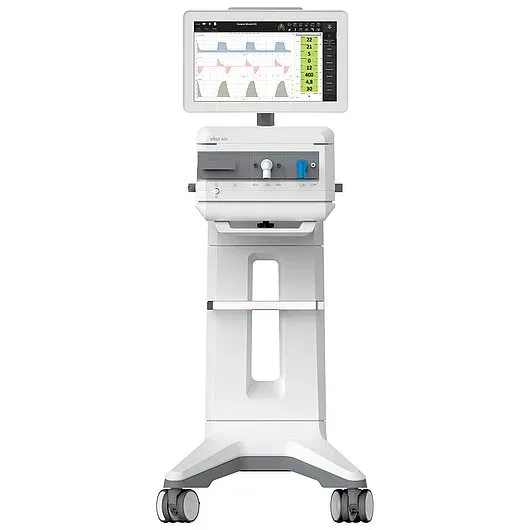
 Zoom
ZoomPricing is provided on request — our specialists will respond.
Overview
Premium class intensive care ventilation As an innovative universal ventilator, elisa 600 is designed for high-flow O2 therapy, invasive and non-invasive ventilation therapy for all clinical pictures and in all specialist disciplines. The smart user interface can be individually adapted to the respective requirements and house standards. The innovative technology, ease of use and comprehensive modular system reduce complexity, avoid operating errors and support the user with ventilation therapy. Article number: ag-370600
Key features
- Non-invasive ventilation
Innovative control technology and special algorithms allow extensive leakage compensation. The adjustable and leakage-compensated byflow reduces CO2 rebreathing at full face masks and ensures patient trigger comfort. Special ventilation modes and adjustable alarm delays reduce alarm stress, even in difficult anatomical conditions and high leakage. For long-term use or in the presence of skin defects, helmet ventilation provides another non-invasive option to avoid intubation and invasive ventilation. Non-invasive ventilation is standard on every ventilator in the elisa family.
- High-flow O₂ therapy
A high-flow of heated, humidified inspiratory gas is applied via a nasal cannula. Depending on the indication and care environment, this inspiratory gas consists of air, an air-oxygen mixture or pure oxygen. Consequently, the effects of the therapy can be seen in elimination of CO2 from the anatomical dead space with reduced work of breathing and improved oxygenation. Thanks to the system architecture of the elisa series, there is no need to replace the breathing circuit when switching between HFOT and non-invasive or invasive ventilation. High-flow O2 therapy is standard on every ventilator in the elisa family.
- LEOCLAC
Automatic regulation of the inspiratory oxygen concentration based on pulse oximetry allows oxygen to be applied in accordance with the guidelines. High O2 concentrations can cause adverse events. The spectrum ranges from inflammatory reactions of the airways, resorption atelectasis and seizures to increased hospital mortality. During high-flow O2 therapy and ventilation, oxygen saturation should be closely monitored and the inspiratory oxygen concentration continuously adjusted to the individual therapy range. LEOCLAC uses integrated pulse oximetry to continuously adjust the inspiratory oxygen concentration to the set therapy range. When combined with invasive or non-invasive ventilation and HFOT, LEOCLAC continuously evaluates the quality of the pulse wave and detects possible artifacts. Various sizes and models of SpO2 sensors are available for LEOCLAC. Pulse rate, O2 saturation and Pleth curve can be monitored independently of LEOCLAC. An intelligent graph facilitates easy assessment of FiO2 control.
- Transpulmonary monitoring as additional option
Lung-protective ventilation reduces ventilator-associated complications, in particular by reducing the mechanical pressure and volume load on the lungs. The findings of recent years show that lung-protective ventilation can only be achieved by regularly adjusting the ventilator settings to the individual lung function. But what happens if the classic requirements for lung-protective ventilation can no longer be met? The adaptation of ventilation therapy on the basis of transpulmonary pressure measurement is a simple, less invasive and valid method that only requires the placement of a modified gastric tube. The changes in esophageal pressure during a breathing cycle reflect the changes in pleural pressure. As the difference between ventilation and pleural pressure, the transpulmonary pressure situation shows the extent of mechanical stress on the alveoli and is thus responsible for ventilation-associated lung damage. The inspiratory plateau pressure set on the ventilator tends to play a subordinate role. Studies have shown that due to the high variability of the ratio of the elasticity of the lungs to the thorax, an inspiratory plateau pressure set on the ventilator resulted in very different transpulmonary pressure gradients. On patients with increased pleural pressure, for example as a result of increased intra-abdominal pressure, the same inspiration pressure may be associated with less ventilator-associated lung injury than on patients with low pleural pressure. The end-expiratory transpulmonary pressure (TPP exp. press.) can then be adjusted by titrating the applied PEEP, as the airway pressure is related to the applied PEEP. In contrast to other procedures for detecting the individual PEEP, this procedure can also be applied during spontaneous breathing and in the course of weaning. Likewise, during weaning, measurement of esophageal pressure can provide valuable information (unmasking of patient-respirator asynchrony, monitoring of respiratory muscle effort, calculation of intrinsic PEEP during spontaneous breathing ...) and allows the weaning process to be optimized. The patient's breathing work can be determined under assisted spontaneous breathing in the acute situation so that the necessary support for the patient can be adapted directly to the respective lung function by means of pressure support.
- PEEPfinder
It is well established that the breath-synchronous collapse and reopening of lung areas in ARDS patients causes considerable damage to the lung tissue and that breath-synchronous opening and closing (alveolar cycling) of lung areas in particular is an independent risk factor for higher mortality. The PEEPfinder can be used to optimize the settings of the ventilator and thus supports lung-protective ventilation. The maneuver is performed in a safe window and can be combined with a preoxygenation function. The upgraded quasi-static PV tool supports the user at assessing stress and strain. Intelligent algorithms and extensive safety functions allow the elastic properties of the lung to be determined easily. Extensive evaluation options are available for this purpose. Graphical evaluation support for detecting inflection points, recording stress indices and saving reference loops make it easy to determine the safe ventilation window.
Technical specifications
Kimia Afiat is the official Iranian representative of Lowenstein Medical (Germany), since 2007.
This device is supplied through official representation — so authenticity, warranty, and parts supply are assured. Installation, training, and after-sales service are delivered inside Iran.
Related products
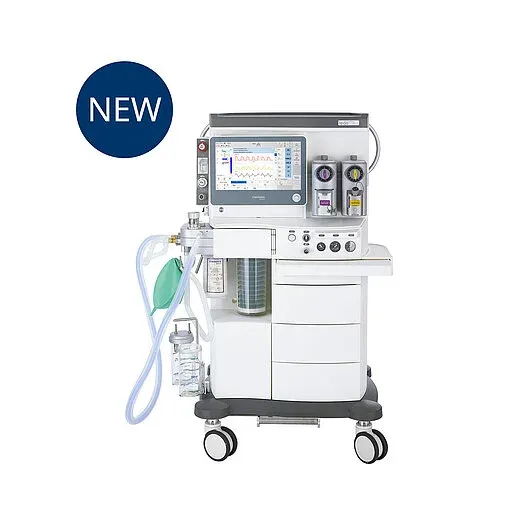 AnesthesiaLEON plus editionManufactured by Lowenstein Medical, GermanySupported locallyView productQuote
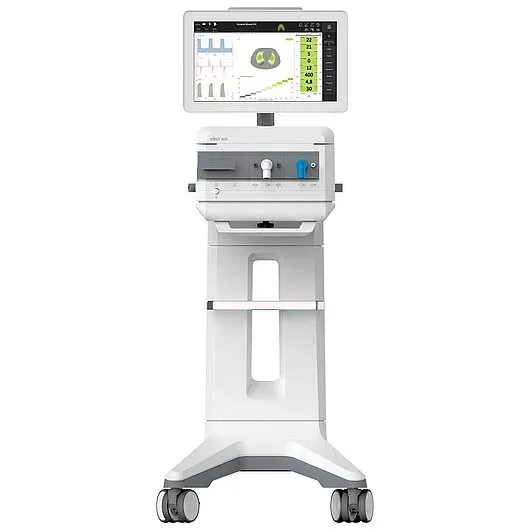 intensive care ventilation and EITelisa 800 R-VITManufactured by Lowenstein Medical, GermanySupported locallyView productQuote
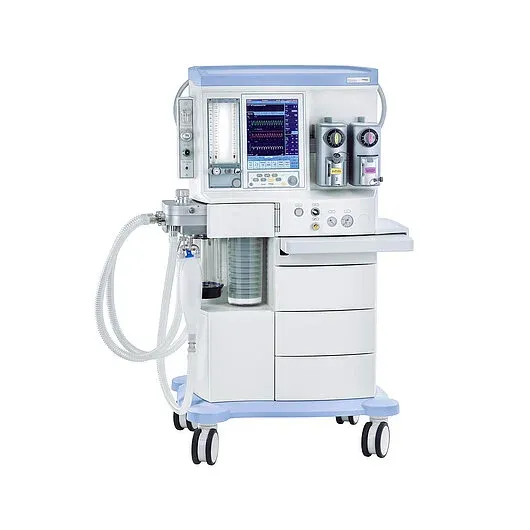 Anesthesia Workstation SystemLeonManufactured by Lowenstein Medical, GermanySupported locallyView productQuote
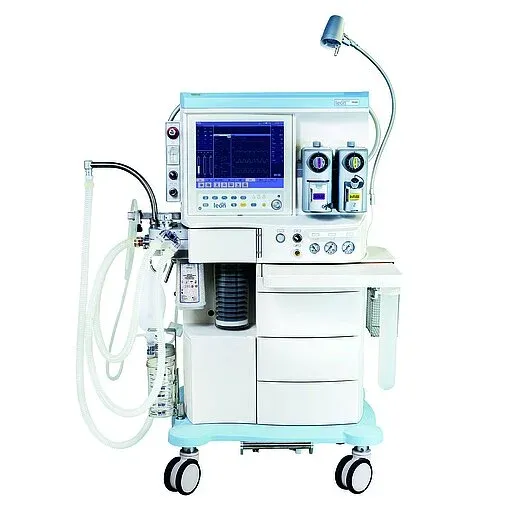 Anesthesia Workstation SystemLeon PlusManufactured by Lowenstein Medical, GermanySupported locallyView productQuote